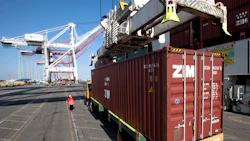
A major global logistics leader has tens of thousands of employees spread across more than 200 countries. It has set ambitious ESG goals, with progress already underway. But with a large, distributed and often transient workforce, any change in culture and mindset requires focus, persistence and broad stakeholder engagement.
The journey begins by gaining foundational alignment across the organization, ensuring that its people have the leadership, competencies, training, organizational structure and individual empowerment to ensure success.
Environmental, health, safety and sustainability (EHS&S) efforts form the core of any ESG roadmap. In a time of growing public scrutiny and heightened focus on ESG, the logistics provider saw the need to bring in an outside EHS&S executive.
The company defined a series of goals and requirements for the position. To be successful, this new leader had to:
- Be clearly aligned with the current and aspirational culture of the enterprise;
- Have an inner “fire” that motivates them to constantly seek out new methodologies and innovations that engage people across the entire organization and supply chain;
- Possess the technical competence needed to translate ESG commitments into EHS&S activities and core key performance indicators;
- Have demonstrated, practical application of transformational programs and the ability to communicate the “why, what and how” of their decisions, working across business functions and with external stakeholders, and
- Have experience gaining buy-in to the pursuit of excellence in EHS&S.
Aligning on these search criteria provided an anchor for careful evaluation and prioritization of candidates. Added benefits of this approach included a reduction in recency bias, clarity on “must-haves” versus “nice-to-haves,” and a definitive assessment of qualitative versus quantitative factors.
The successful candidate needed to have all the necessarily technical, organizational and leadership competencies, while also being able to lead from the heart and be comfortable engaging the entire workforce, regardless of setting.
The solution boiled down to some simple precepts: Be specific. Be focused. Be adaptable. Be decisive.
Identifying the talent pool was the easy part, given that fewer than 200 executives globally had the scale, functional insight and transformational experience needed for success. The real challenges came in three areas, which are a constant struggle for all talent acquisition teams today:
- Candidates often are involved in multiple competing hiring processes, many of them on accelerated timelines;
- Compensation packages required to entice top EHS&S executives have increased with the rise in ESG focus and complexity, and
- Internal company compensation bands may be outdated in relation to current market demands.
Adaptability became a key criterion as the company narrowed the search to a small group of highly qualified candidates. All had compensation targets that required the company to rethink what its offers should look like. It was important to establish appropriate market benchmarks and creative solutions that would limit the impact on the company’s overall compensation structure, while offering candidates competitive, multi-year benefits.
Initial conversations with candidates sought to ensure that they were truly buying into the company’s vision and purpose, and determine what type of compensation package would be required to get to an acceptable offer, before reaching the point of discussing an offer.
Relying on the search criteria laid out early in the process, the hiring team was able to force-rank and identify the top two candidates, then overlay compensation insights in order to make the right choice. It was essential to be decisive in closing on the preferred candidate; any delay could put the entire search process at risk and cause the favored candidate to choose other offers.
The compensation and benefits team ended up slightly modifying the offer structure to one that was comfortable for both candidate and the hiring company. After minimal negotiations, the candidate accepted the offer and is now fully onboard, driving change across the function and broader organization.
In the end, the company was able to hire a top candidate with demonstrated success at:
- Setting ambitious yet attainable EHS&S goals which support ESG as a whole;
- Understanding the competencies, capabilities and tools needed to have impact today while also building for the future;
- Developing an action-oriented, step-by-step roadmap on how to push beyond comfort to maximize results, and
- Fostering a purpose-driven culture that can keep pace with the dynamics of day-to-day challenges.
The search team invested significant time and effort on candidate assessment, competency analysis, reference checking and confirmation of candidates’ personal connection both to the EHS&S function and broader ESG mission at hand. The company reviewed more than 50 candidate profiles and conducted numerous multi-stakeholder interviews, all within the targeted timeframe. While the chosen leader is still early in their tenure, feedback from stakeholders has been overwhelmingly positive, and expectations of their impact to the enterprise ESG program are high.
Greg Desnoyers is senior client partner at Korn Ferry.
Read more of SupplyChainBrain's 2022 Supply Chain ESG Guide here.