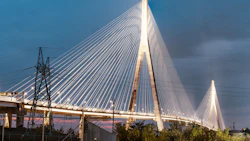
A celebration marking the much-delayed opening of the Gordie Howe International Bridge between Ontario and Michigan took place July 24, reports CNBC. The ceremonies, however, went ahead without U.S. officials and VIPs, after a spat between Canada and the U.S. regarding President Donald Trump's latest threatened tariffs of 25% on a wide swathe of goods, which are due to come into effect August 19. On July 21, Canadian leaders told Michigan officials the planned joint U.S.-Canada event would not go ahead.
"The July 24, 2026, event for the Gordie Howe International Bridge has been cancelled," according to an email sent late on July 21 from the Windsor-Detroit Bridge Authority to one U.S. elected official, reports The Detroit News. "We appreciate your interest. We regret any inconvenience and appreciate your understanding."
The $6.4-billion cable bridge, the newest route between Windsor, Ontario, and Detroit, one of Canada's busiest commercial border crossings, is set to open to traffic on July 27 after months of postponements. Whether the Customs & Border Patrol staff needed to receive traffic on the U.S. side are actually deployed on that day remains to be seen.
In February, Trump indicated plans to block the project’s completion, in an attempt to force Canada to rethink the deal on splitting revenue after construction costs had been paid off, and as part of wider disagreements between the U.S. and its second-largest trading partner. Critics also point to the fact that billionaire Matthew Moroun, owner of the rival Ambassador Bridge, donated $1 million to the pro-Trump super PAC MAGA Inc. shortly before President Trump moved to block and delay the opening of the competing bridge.
On July 21, Canada announced a "proposed agreement in principle" under which Canada, which paid for the bridge, will receive 50% of net toll revenues for the first 15 years of the bridge's operation. The other half will go toward an economic development fund "solely controlled" by the U.S. Officials disagreed about whether or not this represented a change of any kind from the original agreement.
Trump demanded in a social media post in February that the U.S. needed to be “fully compensated for everything we have given” Canada, “and also, importantly, Canada treats the United States with the Fairness and Respect that we deserve.”
Canada stands virtually alone in pushing back publicly against the Trump administration’s tariff policies, with the province of Ontario taking all U.S.-produced alcohol off its shelves in 2025, and retaliatory tariffs introduced by Canadian Prime Minister Mark Carney. In an interview with the Council on Foreign Relations in May 2026, the U.S. Trade Representative Jamieson Greer said Canada was the only country apart from China that had retaliated against the U.S. over tariffs.
Many Canadians remain perplexed and angered by the deterioration in what was previously one of the most reliable trading alliances in the world, worth more than $900 billion in 2024, before Trump began his second term. "We're dealing with an administration like we've never seen before," Colin Robertson, a former Canadian diplomat and a fellow at the Canadian Global Affairs Institute, told the BBC in an interview on July 24. "They renege on deals. They don't follow agreements. It's like dealing with pirates."