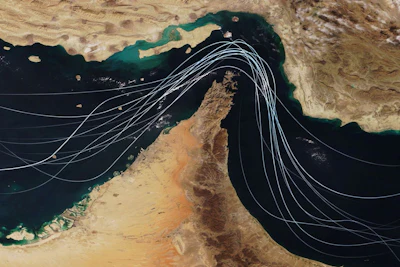
At least eight tankers have been attacked around the Strait of Hormuz since September 28, as renewed hostilities threaten recent progress in moving oil through the region.
The Wall Street Journal reports that seven of the vessels that were targeted were attacked near the narrowest part of the Strait of Hormuz, while it remains unclear where the eighth attack took place. Iran's Islamic Revolutionary Guard Corps also issued a warning on October 3 to ships using a U.S.-defended route through the strait.
"Don’t trust U.S. Navy, don’t use south corridor at all and don’t put your life in danger," the message, transmitted over radio on a public shipping channel, said.
The renewed attacks come after the flow of oil out of the Persian Gulf had rebounded to pre-war levels, with roughly 40% of the region’s oil reportedly having bypassed the Strait of Hormuz. Of the oil moving through the strait, 70% has relied on a shuttle tanker system that transfers crude to chartered vessels for passage through more dangerous areas. However, that recovery has since faltered, with Commodity Context founder Rory Johnston telling The Journal that the recent attacks have pushed daily crude exports back down to 2 million to 3 million barrels below pre-war levels.
“The recent pace of flows, while impressive, has never been sustainable and has already come at great expense,” Johnston said, pointing to how gulf oil producers are spending up to $40 million per roundtrip shuttle-run in and out of the Strait of Hormuz.
Oil prices in the meantime have yet to come down, as the market has remained skeptical of long-term recovery in the Gulf region, and global stockpiles have depleted. G7 nations also recently announced the release of up to 100 million barrels of emergency diesel and crude oil stockpiles in hopes of easing prices, and to placate President Donald Trump, who has floated potential plans to cut off U.S. diesel exports.


