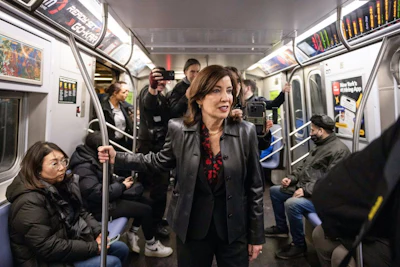
New York Governor Kathy Hochul wants the Trump administration to exempt purchases of New York City subway cars and buses from tariffs to avoid $1 billion in added fees for the nation’s biggest transit system.
The state-run Metropolitan Transportation Authority, which oversees the city’s subway, bus and commuter rail lines, plans to invest $23 billion over the next few years to buy nearly 9,000 subway cars and commuter coaches and about 5,800 buses as the agency overhauls its decades-old trains and buses. But the White House’s sweeping tariffs threaten to add $1 billion in potential levies, and to force the agency to scale back needed upgrades, Hochul warned U.S. Commerce Secretary Howard Lutnick and U.S. Trade Representative Ambassador Jamieson Greer in a letter on September 30, asking them to remove such fees.
The MTA needs to upgrade nearly 2,000 subway cars that were purchased in the 1980s, as older railcars break down more frequently. About 40% of its bus fleet will be up for replacement in the next few years. LIRR coaches and locomotives are also nearing the end of their useful life.
The estimated $1 billion of additional expenses could be redirected away from tariffs to replace most of Metro-North Railroad’s train cars, or buy 150 Long Island Rail Road coaches, or 1,000 new buses or 280 subway cars, according to the transit authority.
“This tax on transit is forcing the agency to make difficult decisions about upcoming investments that will impact service for millions of daily riders,” Hochul wrote in the letter.
The MTA faces an uphill battle with the Trump administration as the White House has been critical of how mass-transit agencies handle crime on their systems as well as initiatives to contract with minority-owned businesses. President Donald Trump has tried to stop federal funds from going to major projects like expanding New York City’s Second Avenue subway and a new passenger rail tunnel under the Hudson River for Amtrak and New Jersey Transit trains.
If transit agencies use federal funds to help buy new trains and buses, 70% of their parts must be made in the U.S. and also assembled domestically. For some new vehicles, up to 30% of their components come from outside the U.S. The recent tariffs are pushing up prices on those foreign-made parts, including wheels and axles, vehicle frame parts, electronics and controls and seat frames, according to an MTA presentation.
Material costs per train car have increased by nearly 28% over the last 19 months, according to Jessie Lazarus, head of the MTA’s new rolling stock program. An exemption from tariffs on those parts would be similar to the relief provided to the automotive and agricultural heavy machinery industries, Lazarus said.
“If it is not contained, it will force us to make difficult decisions about upcoming investments,” Lazarus said on September 30, during an agency board meeting about the rising costs. “And it’s going to impact the service we deliver for riders and of course the American manufacturing jobs sustained by our rolling stock investment.”
Earlier this month, U.S. transit officials met with U.S. Transportation Secretary Sean Duffy in Washington D.C. to discuss federal funding and tariffs, according to Janno Lieber, the MTA’s chief executive officer.
“The tariffs are killing us,” Lieber said during a Citizens Budget Commission event in midtown Manhattan last week. “The components that they have to buy through the manufacturing in the U.S., we tariff them like crazy now, thanks to Washington. So the result is federal dollars that go into buying rail cars deliver fewer jobs and fewer rail cars.”


