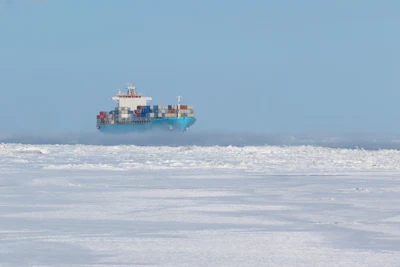
As disruptions through key shipping routes in the Middle East have grown from short-term annoyances into long-term turmoil, the need for viable alternatives has never been greater. But in today's world, the maps have already been drawn, and if there were better, more efficient options, we would already be using them. That's had countries like South Korea and China turning their attention north... way north, to the frozen waters of Arctic Circle, as they pin their hopes on a seldom-traveled 3,500-mile path known as the Northern Sea Route.
The NSR follows Russia's northern coastline along the Arctic Ocean, spanning the Bering Strait in East Asia, to the Kara Sea in western Siberia, offering the shortest shipping route between western Eurasia and the Asia-Pacific region. Historically, the route has only been navigable for a handful of summer months, when Arctic sea ice melts enough to allow ships to pass through. Climate change has gradually widened that window, though, with the region's ice coverage having fallen by a third since 1979.
For some, that's being viewed as an opportunity. Chinese shipper Sea Legend started the world's first regular cargo service through the NSR in August, and claims that the route can halve emissions and provide significant savings on fuel costs compared to longer voyages through the Suez Canal and around Africa's Cape of Good Hope. South Korea also successfully completed its first ever round-trip commercial journey through the NSR in October, shaving 10 days off the time it would have taken to reach Europe through the Mediterranean.
For other shippers and carriers, weighing the viability of the NSR can be broken down into a few factors, says Eric Fullerton, VP of data insights with freight intelligence platform project44: speed, disruption, cost, reliability and readiness.
The NSR has its marked advantages when it comes to speed and disruption — it's roughly 18-20 days on the NSR between Ningbo, China, and the first available European port in Felixstowe, U.K., compared to the 27-30 days it takes to get to Europe via the Suez Canal, or 40 days to go around Africa's Cape of Good Hope.
However, the math starts to fall apart when you get to things like cost.
“The biggest barrier is that it’s more expensive,” Fullerton says, pointing to how limited capacity and infrequent sailings make it expensive to ship through the NSR, on top of additional costs created by the need for ice-capable vessels, and potential icebreaker escort fees.
Things break down even further when you look at reliability and readiness. Ongoing Western sanctions against Russia currently restrict carriers’ access to Russian icebreaker escorts, as well as other vital support services that might be needed along the route, such as refueling, port handling, repairs, towing or salvage.
Between those sanctions, and the risks posed by the route itself — from unpredictable icy conditions to a lack of emergency resources in the remote Arctic region — asking most insurers to agree to cover a trip through the NSR is a tall order, says Dennis Marvin, head of marine at specialty P&C insurer MSIG USA.
A grounded vessel spilling oil along the NSR could create catastrophic liability issues for cargo and vessel owners, Marvin explains, given that it could take days, or even weeks, for help to arrive. Each of those days spent waiting means more time for oil to spread, potentially increasing the environmental damage and the eventual cleanup costs owners could face.
"We have a long way to go before the Northern Sea Route is really open and operating efficiently," Marvin notes.
Liability is also just the tip of the iceberg when it comes to the environmental obstacles posed by opening the NSR up to commercial shipping. An oil spill in the Arctic would be nearly impossible to clean up, warned the nonprofit Bellona Environmental Foundation in a 2025 report, due to the vast distances that specialized vessels have to travel, the difficulties associated with recovering oil once its frozen, and the fact that oil degrades far slower in cold waters than it does in warmer areas.
Then there's the risk of noise pollution from ship engines that can disrupt the lives of marine mammals like whales and seals, who rely on sound to communicate and navigate. Perhaps most concerning, though, is the fact that any uptick in commercial traffic is going to introduce more greenhouse gas emissions into a delicate ecosystem, which risks accelerating the climate change impacts that are already melting Arctic ice at alarming rates.
"The very forces that make the NSR more accessible are the same ones that jeopardize the region’s unique biodiversity and climate stability," Bellona says.
It's those concerns that have motivated some of the world's largest ocean carriers to swear off the NSR altogether. In 2019, CMA CGM labeled commercial use of the NSR as "a significant danger to the unique natural ecosystems of this part of the world." MSC echoed those sentiments in a 2025 notice, citing how an increase in traffic could "impact the fragile ecosystem of the region and icecaps."
While that hasn't dampened the ambitions of South Korea or China, it speaks to a wider reluctance to invest in a shipping route that remains a long way off from being considered commercially viable by the greater maritime sector.
“There’s definitely some advantages, but the disadvantages seem pretty stark,” Fullerton says.


