For years, transportation procurement has largely followed a familiar playbook. Shippers issue an annual request for proposals, carriers submit rates, and those contracts are expected to hold steady until the next bidding cycle. Today, that approach has become much harder to sustain.
As freight markets tighten, regulatory changes have reshaped carrier capacity, and transportation costs have become less predictable. As a result, many shippers are finding that traditional requests for proposals (RFPs) offer less certainty than they once did. Carriers that agreed to rates months earlier may no longer be able to honor them, while market conditions can change long before annual contracts expire.
"We're seeing some customers shift their attention," says Jordan Strawn, SVP of brokerage and PowerLink for Werner. “Shippers are reevaluating freight that has traditionally moved as a one-way truckload shipment and are exploring whether those lanes would be a better fit for dedicated transportation if current market rates remain elevated.”
Those changes are prompting many supply chain leaders to rethink transportation procurement altogether. Instead of treating truckload, intermodal and brokerage as separate purchasing decisions, more companies are evaluating how those services can work together to create greater flexibility when market conditions inevitably change.
The Market Reality: Regulatory Hits and the "Flight to Quality"
Transportation markets rarely stand still, but 2026 has presented a particularly challenging environment.
A combination of tightening trucking capacity, regulatory enforcement, higher operating costs and continued market uncertainty has made long-term pricing much harder to predict. As carriers become more selective about the freight they accept, many shippers are supplementing annual RFPs with smaller, targeted bids throughout the year to fill gaps in their routing guides.
Nathan Browne, SVP of intermodal and final mile for Werner, describes today's procurement environment with one word: "I would say ‘volatile.’"
That volatility extends well beyond freight rates. Regulatory changes are also affecting the available supply of trucking capacity as carriers place a greater emphasis on safety compliance and operating standards.
Strawn says stronger enforcement has encouraged carriers to devote even more attention to safety practices, but that can also reduce available capacity.
"When you focus heavily on safety, you do things right, and in doing things right, that increases transit time, which reduces capacity in the marketplace," he explains. "Some decide to completely leave, but even those that don't now have a reduced capacity in the marketplace."
The result is what many in the industry have described as a "flight to quality," with shippers placing greater value on providers that demonstrate consistent safety performance, dependable capacity and operational discipline.
Browne believes those conversations are becoming a much larger part of transportation procurement, especially after the U.S. Supreme Court ruled in May that freight brokers can be held liable for hiring unsafe motor carriers.
"I think it's going to change the way some shippers manage their carrier base," he adds. "It should always have been that way, but I think that the ruling makes it even more important for shippers to pay attention to safety and compliance standards."
Beyond the RFP: Moving from Transactional to Strategic
For decades, transportation procurement has often focused on finding the lowest rate for individual lanes. That transactional approach works well when market conditions remain stable, but it becomes much more difficult when capacity changes throughout the year. Suffice it to say, today's environment requires a broader view.
Instead of evaluating transportation modes independently, more shippers are examining how their freight network fits into a carrier's broader capabilities. From there, the goal becomes building transportation plans that remain flexible even as markets fluctuate.
Browne says achieving that begins with understanding the full range of services available from transportation providers, rather than simply comparing rates on a spreadsheet.
"There may be a customer that has a large concentration of volume shipping out of one place," he says. "The approach we would take is leveraging the portfolio of solutions."
Taking a broader approach can simplify operations while creating some much-needed flexibility. Shippers can then set up their transportation modes based on the specific needs of each lane, balancing service requirements, capacity availability and cost.
However, that strategy also depends on tighter collaboration and better communication between shippers and carriers. "The more we get line-of-sight into customer forecasting, the more predictable we can get with our network," Browne says.
Strawn expects that collaboration to extend beyond transportation departments and into purchasing decisions.
"You'll start to see their buying patterns change," he says. "Buyers are now going to have to be more strategic – down to days of the month, days of the week, to try to create some of those consistencies."
The Intermodal Integration
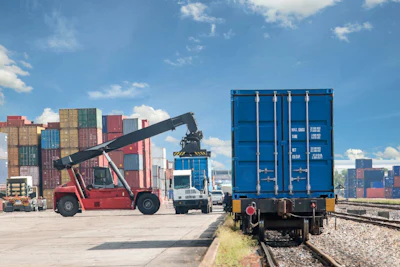
One of the biggest opportunities for building flexibility comes through greater use of intermodal transportation.
Historically, intermodal was often reserved for predictable, long-haul freight where transit times were less critical. Improvements in rail service have increased the opportunities to make that mode fit into transportation networks.
Browne says customers are becoming more comfortable using intermodal for freight that previously would have moved exclusively by truck. "We are seeing the best service numbers that we've seen from the railroads, consistently," he says. "That gives shippers more confidence in being mode diverse."
Flexibility becomes especially valuable when trucking capacity tightens, allowing shippers to spread freight across truckload and intermodal, so that each mode can absorb fluctuations in demand.
Intermodal also addresses one of the industry's largest long-term challenges in driver availability. "When you send a driver from Chicago to Los Angeles cross-country, you're losing that driver for more than a week," Browne explains. "When you ship an intermodal shipment, that driver stays local — there are multiple shipments a day, and you don't lose that capacity for days or weeks at a time."
Beyond capacity, intermodal can also help lower transportation costs on certain lanes while reducing carbon emissions and giving shippers another tool for building a more resilient and flexible transportation network.
Case Studies in Resilience
Building resilience ultimately comes down to having options before disruptions occur.
Holiday shipping peaks offer a clear example. Retailers routinely experience sharp increases in freight volumes during seasonal surges, putting additional strain on available trucking capacity.
Browne describes a customer facing a 20% increase in freight volume during peak season. If every shipment depends on truckload capacity alone, finding enough equipment becomes much more difficult. A transportation plan that already includes intermodal options provides additional flexibility to absorb those surges.
The same principle applies throughout the year whenever unexpected disruptions affect one transportation mode over another. Weather events, regulatory changes, fuel costs or regional capacity shortages can all put added pressure on individual modes in a transportation network.
A mode-diverse strategy allows freight to shift between available options instead of forcing shippers into expensive last-minute decisions.
But for Browne, resilience begins long before disruptions appear.
"If you're a shipper that has a more diverse approach to your network, you're probably a little bit insulated because you can lean on more than one solution,” he says.
Strawn offers an even simpler summary. "It's really kind of basic," he says. "You’ve got more options — it's all about optionality."
As transportation markets continue to evolve, that flexibility may become one of the most valuable assets of any supply chain. Annual RFPs will remain an important part of procurement, but resilience will depend on what happens after those bids are awarded. In the end, organizations that combine multiple transportation modes, share better forecasting information and build stronger carrier partnerships are always going to be in a better spot to adapt as conditions change throughout the year.
Resource Link: https://www.werner.com/supply-chain-solutions/


.png?ar=16%3A9&auto=format%2Ccompress&dpr=2&fit=crop&h=135&q=70&w=240)


.png?ar=16%3A9&auto=format%2Ccompress&dpr=2&fit=crop&h=135&q=70&w=240)


