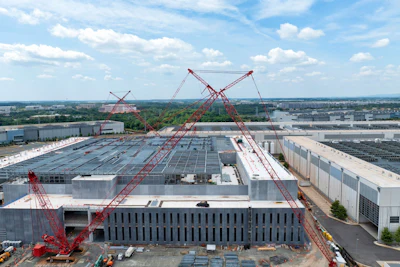
For all the talk of artificial intelligence's role in transforming the world as we know it, none of that is possible without the data centers that power the technology itself. But as these data centers have spread across the country, local communities are beginning to push back against facilities that have strained their power grids and water supplies, and seemingly taken more than they've given.
According to data from ConstructionConnection, data center projects entering construction in the United States surged by 190% year-over-year in 2025. The World Resources Institute estimates that a single one of those facilities can consume as much power as 100,000 homes, while many of the larger data centers being built today could consume up to 20 times that much energy once they come online. A single mid-sized data center also needs the equivalent of 1,000 households worth of water for cooling purposes, with larger facilities requiring as much as a town of up to 50,000 people.
While advances in more efficient closed-loop and direct-to-chip cooling systems can cut water usage by as much as 70%, the technology hasn't yet become widespread enough to offset the rapid pace of data center growth. Additionally, those systems can often require more electricity to release heat without relying on evaporation.
Read More: How Water Risk is Threatening the World's Supply Chains
On top of all that, residents living near data centers have frequently complained of constant humming noises emitting from facilities, with reported noise levels reaching 96 decibels, equivalent to a gas-powered lawn mower or a food blender set at maximum speed. Neighbors have also reported headaches, vertigo, nausea, sleep disturbances, ear pain and hypertension stemming from data center noise.
As concerns have mounted among local communities, federal oversight remains fragmented across executive actions, grid rules, and environmental guidelines, leaving states to take the lead. In July, New York enacted the country's first statewide moratorium on data center approvals, in force for up to one year. Texas followed suit less than a month later, while other temporary bans have taken hold in cities in Missouri, Indiana, Georgia, Colorado, North Carolina and Washington state.
But these moratoria, in turn, are often in response to a wave of outrage from local communities. Festus, Missouri — a town of 12,000 people just outside of St. Louis — forced a vote to remove its mayor in April, and ousted four of its eight sitting council members, each of whom had voted to approve a $6 billion data center. In Yukon, Oklahoma, voters are holding a November recall vote for their mayor, who helped facilitate the sale of land to a data center developer. The mayor of Independence, Missouri, faces a similar recall push set for September, after he voted to award billions of dollars in tax breaks to a $150 billion data center project.
While concerns over power, water use and noise are certainly a factor in this outrage, the larger issue at play is the growing lack of trust between the developers building these data centers, and the people living next door.
"The massively negative pushback is due to one glaring mistake: the utter lack of transparency by both the companies involved in building and managing these initial data centers, and the elected agencies who approved them without proper public buy-in," says Christopher Lee, partner and senior political strategist with policy consultancy Foresight Strategic Advisors.
"When you obfuscate something, then trust is not there," says Jason Williamson, CEO for AI company Mythworx, whose team operates a data center in Virginia. "Where the policy needs to catch up is requiring developers to be transparent in their usage and their impact."
There are also no laws that require data center developers to disclose their water or energy use, with many choosing to classify that information as proprietary. And companies that run the facilities will often claim that sharing too many details about how they operate could create significant security concerns, or provide valuable insights into their inner workings, to be exploited by their competitors.
Much of the work behind the scenes for funding and approving new data centers is largely opaque as well. According to policy resource group Good Jobs First, of the 36 states that have economic development subsidies specifically crafted for data center projects, just 11 disclose the companies that receive those subsidies. Of those 11 states, none disclose the corporate parent company behind the subsidiary that's getting the money, while only five disclose the actual amounts of the subsidies themselves.
That secrecy has made it difficult for communities to know exactly what they're signing up for, and what it might cost them — both financially and environmentally — until a project is already well on its way toward approval.
However, simply imposing an open-ended moratorium on approving new data centers is not a permanent solution.
"Let's be real clear, AI isn't going anywhere," says Lee.
Williamson adds that any pause must come with some sort of end-goal for both sides, lest it drag on indefinitely with no path forward. That means having communities offer clear, actionable demands for developers, he posits, while developers will need to find a better way to balance transparency with security concerns.
In the meantime, however, a moratorium can buy valuable time for local regulations to catch up.
"Moratoriums can create a useful reset — not to stop innovation, but to establish stronger standards around infrastructure costs, resource use, community engagement, and tangible local economic benefit," says Steven Cornwell, global director for urban planning consultancy ERA-co.
A future that works for all parties, he adds, is one where earning a social license to operate is just as important as getting regulatory approval. For developers, earning that trust starts with engaging residents early, investing in local infrastructure, sharing more of the economic benefits, and designing facilities that feel like part of the community instead of something imposed on it.
That level of community engagement is what Lee describes as "the smartest path of least resistance."
"By being smart and strategic in community investment — paying for local projects, sponsoring community activities, creating real jobs — and shrinking their environmental footprint, this will ensure these data centers are supported locally, and built," he says.


