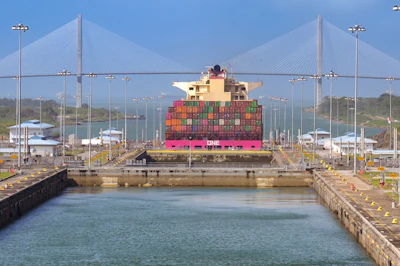
The Panama Canal is limiting daily vessel transits for September, as historic drought conditions continue to fuel concerns over water levels.
According to an August 24 alert from logistics company Kuehne+Nagel, the Panama Canal Authority will cut daily transit capacity from 36 to 34 vessels on September 3, and then again to 32 vessels on September 15. This is only the second time the canal has ever imposed caps on daily transits, after rainfall in the region between May and August came in 34% below average.
“Current watershed conditions, including below-expected precipitation, require additional action to support the long-term sustainability of transit operations,” the canal authority said in an August 20 shipping advisory.
Read More: Supply Chains Brace for Looming Threat of Super El Niño
From September 3, daily capacity at the canal's Neopanamax locks will fall from 10 slots to nine, while capacity at the older Panamax locks will drop from 26 to 25, before falling again to 23 slots from September 15. The authority will also overhaul its system to auction off slots, by dividing daily auction capacity into four cargo categories: Gas carriers, dry bulk vessels, container ships and car carriers, and tankers. The hope, the authority said, is to spread capacity more evenly across the four segments.
The canal authority already implemented a schedule for vessel draft restrictions, from 40 feet in July, to 48 feet from August 26, and then to 47.5 feet starting on September 3. Wait times at the canal have continued to climb in the meantime. Vessels without reservations are facing delays of more than a week, while lengthy queues have sent auction bids soaring for ships looking to jump the queue.
Dry conditions are expected to persist through the winter months, as a powerful Super El Niño threatens to further suppress rainfall across the canal’s watershed. The U.S. Climate Prediction Center warned in mid-August that there's a nearly 70% chance that the October-December 2026 El Niño season could be the strongest the world has seen in 76 years, raising Pacific Ocean surface temperatures, and bringing historically intense drought conditions to much of Central America.


